CloudEffects

OS iXanagi

Understand structure. Connect knowledge. Shape the future.

OS iXanagi recomposes scattered information — not as mere data, but as concepts, relationships, and context.

The first step

Two ways in. Pick the one that fits your business.

Putting your business onto the OS iXanagi foundation starts in one of two places, depending on where your business is today. Either way, the AI drafts and you decide.

Starting a new business

Write your business definition together with the AI.

Put your business into words and translate it onto the OS iXanagi foundation. You never start from a blank page — you correct the AI's draft on the spot.

  1. Just talk with the AI
  2. Correct what is off, right there
  3. Once defined, move straight on to automation
Already running a business

Bring in your current site, as it is.

Your current site's articles, images and URLs are read in as they are. Nothing has to be re-entered. The articles are grouped by topic and become your company's knowledge.

  1. Read in your current site
  2. Articles, images and URLs come along as they are
  3. Approve how the topics connect, and it becomes knowledge

THE PROBLEM

A smarter AI won’t make your business smarter.

Write this. Summarize that. Translate it. Anyone can do that now. But you still cannot ask it about your own business — because the knowledge, judgment, and customer signals you’ve built up aren’t in a form AI can use. However smart generic AI gets, it knows nothing about your business, so it guesses from scratch, every time.

There is one reason: the AI does not know your company. Explain from zero each time and you get an answer — but then you are the one thinking, not the AI.

What’s missing isn’t a smarter AI.

Do not make the AI smarter. Make the company readable by AI.

The knowledge, judgment, and customer understanding your business runs on — its meaning — isn’t in a form your AI, your tools, or your next hire can use. What’s missing is a foundation of meaning. Your part is to look at what it produces and decide: keep it, or not.

Human-in-the-loop

You just decide.

You sit above the AI. The AI runs the work, but you make the calls. The AI is your agent — never your master.

Sending, publishing, money and deletion happen only with your approval, or within a scope, budget and time limit you set when delegating to the AI. Knowledge, too, is adopted by you as a rule. The exceptions are items whose basis is confirmed in the source material, and items you chose to adopt in bulk at import — and in both cases the reason is recorded. Who asked, what ran and who approved it are recorded.

Who runs it

You do not need a team. You need someone who can decide.

AI can propose endlessly. Without someone to say “that is not how we say it”, only the volume grows.

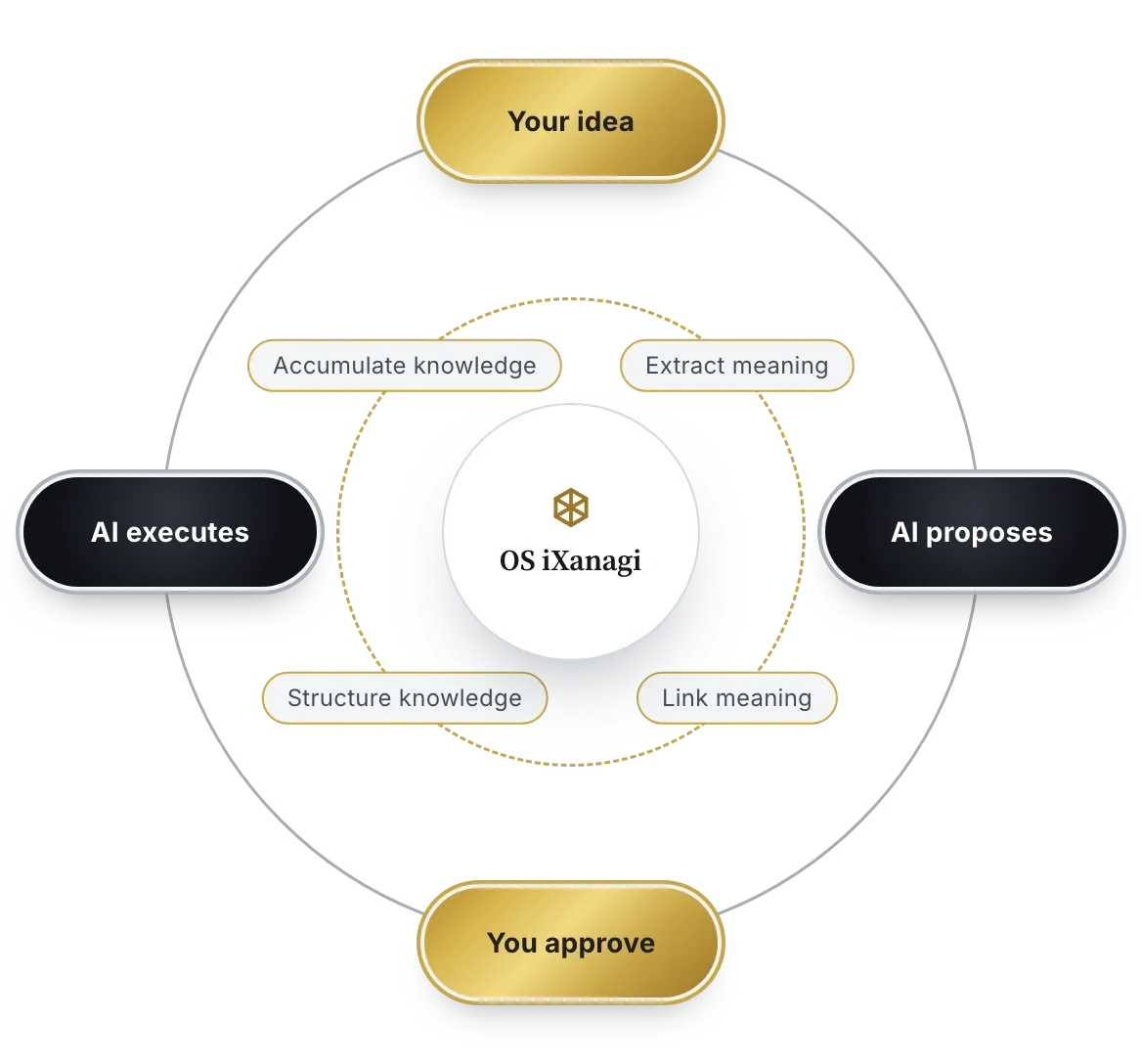
You

Your idea

“I want this.” “That is not right.” It always starts with your words — a document, a conversation, a recording.

Inside: meaning is extracted

AI

AI proposes

It links what it extracted and proposes — “shall we write this?”, “shall we fix that?” — with reasons. This is where the AI’s job ends.

Inside: meaning is linked

You

You approve

Read, decide. What you need is not a team but someone who can say “that is not how we say it”. About one or two hours a week.

Inside: knowledge is structured

AI

Fixed code carries it out

After approval, it is not the AI that carries the work out but code with a fixed procedure. What was done is recorded, and becomes material for the next proposal.

Inside: knowledge accumulates

What becomes possible

Five things you could not do before.

Not “more convenient”. These were simply not options before.

Your days

What do you actually do?

Look at it case by case. On every one of these days, your part is to read and decide.

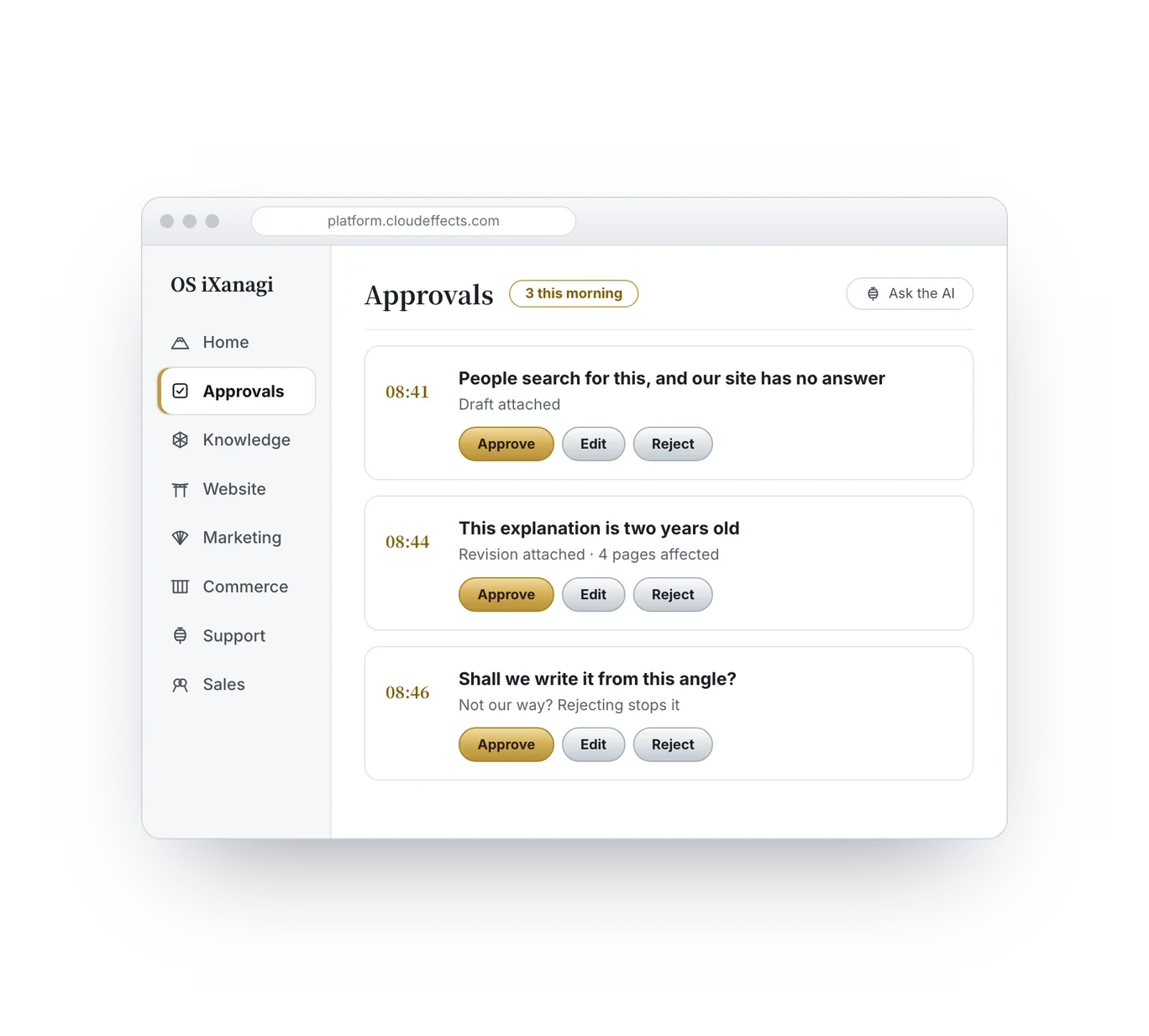
Every morning
1Every morning

Open the approval inbox. Three are waiting. Read, decide. Six minutes. Writing, researching and coming up with ideas stop being your job.

1 / 5

Screens are drawn for explanation. Details differ from the actual product.

Workflows and automations

A step list for the work, and a timer to start it.

At the heart of OS iXanagi are these two. The names sound technical; what they do is familiar.

Workflow

A step list for the work

Think of a recipe. “Chop, fry, taste, serve” — written down, anyone follows the same steps.

In OS iXanagi, work you do the same way every time becomes a workflow, and the AI follows it. At the points where you decide — the “tasting” in the recipe — it always stops and waits.

  1. AI

    Visit the supplier page of every listed item

  2. AI

    Find sell-outs and price rises, and list them

  3. You

    Decide: pause or keep (it always stops here)

  4. AI

    Update the listings as decided

Automation

A timer that starts it

Think of a rice cooker’s timer. Set it at night, and breakfast rice is ready in the morning.

Book a time on the workflow — an automation — — “every morning at 7”, “the 1st of each month” — and it starts even while you sleep or forget. Instead of a time, an event such as “when an order comes in” can start it too. In the morning you find the results, and only what needs your decision.

Every day, 7:00Stock rounds
Mondays, 9:00Last week’s inquiries, summed up
1st of the month, 9:00Last month’s real profit
When an order comes inThank-you note and shipping prep

Ask in words

Say what you want — “check for sell-outs every morning and tell me”. We build the workflow with the AI and hand it to you. No technical skills needed.

You choose where it stops

Before anything goes to customers, before money moves — put your approval in the places that matter.

Everything it did is kept

When, what, and in which workflow — you can always look back.

From the developer’s notebook

Where your actual work gets easier.

I’ve built OS iXanagi with my own hands. These are the moments when I caught myself thinking, “wait — it can even do this?”

It hit me: a human could never build this knowledge graph.

The site’s link map built itself.

Tags and categories just… disappeared.

What I asked the AI actually stuck.

I haven’t copy-pasted the same blurb twice since.

It pulled the meaning straight out of a voice memo. Wild.

It tells me exactly what I forgot to update.

What I said in my own videos became material for articles.

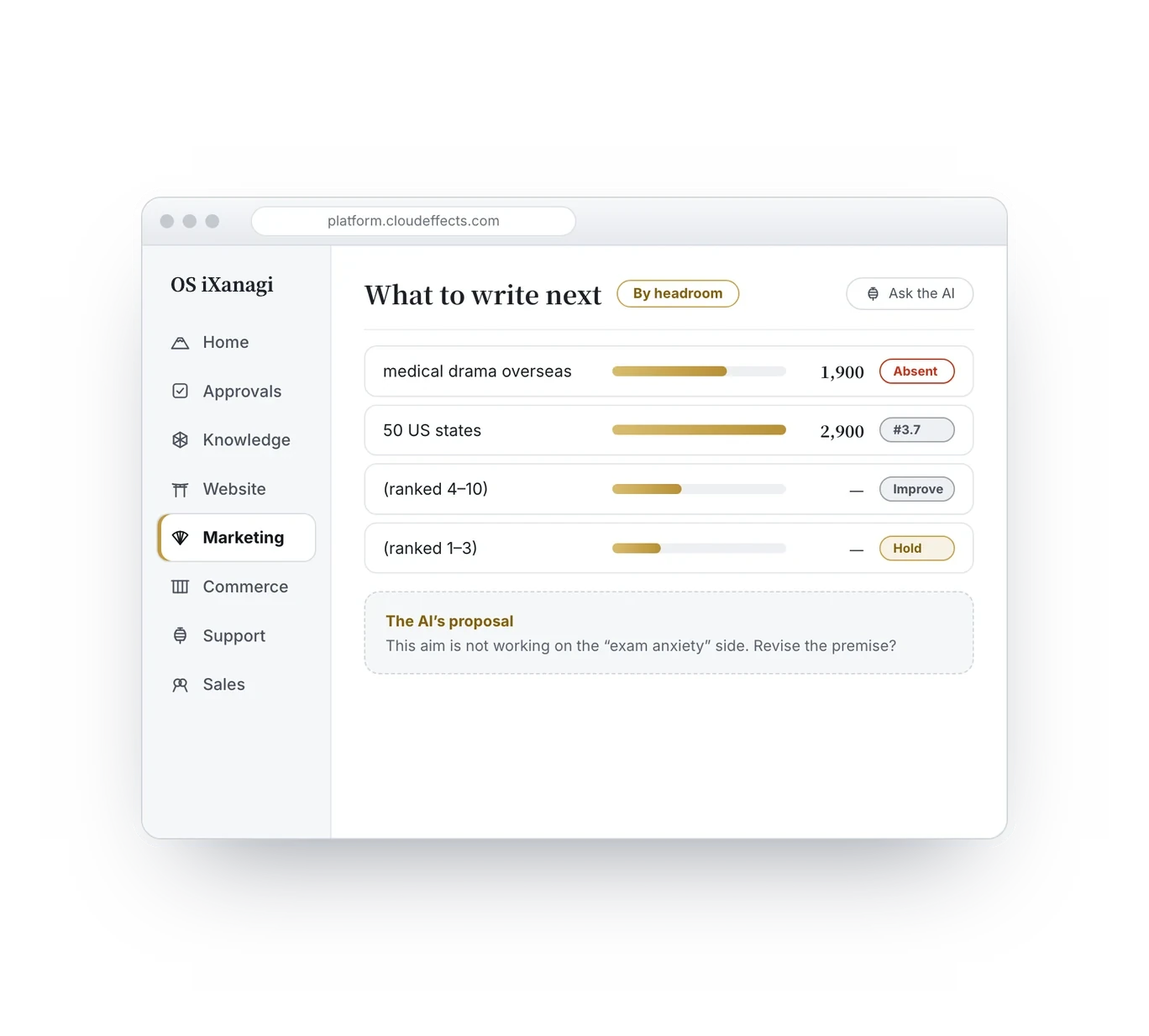
“What should I write next?” — and the AI answered, with reasons.

What could it do for your business?

Curious? Ask the AI directly.

Ask the AI
Work that disappears

Re-pasting links

Until now: whoever hunted through articles after each product change

Work that disappears

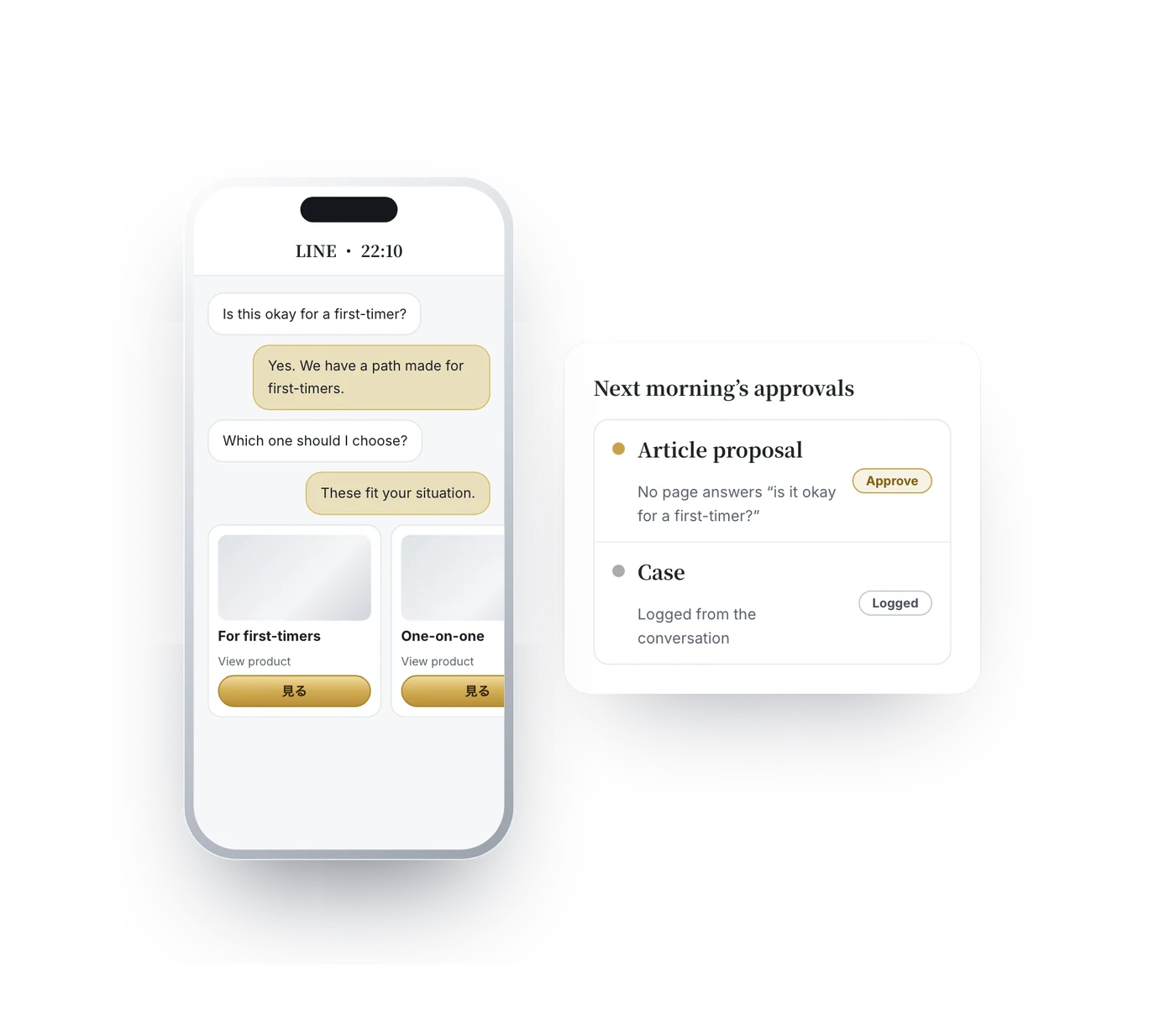
First response at night and weekends

Until now: you, checking your phone

Work that disappears

Finding topics

Until now: whoever stalled at “what next?”

Work that disappears

Rewriting per channel

Until now: whoever wrote the same thing three times

Work that disappears

Copying inquiries over

Until now: whoever copied chat into the ledger

Others vs OS iXanagi

Different from the ground up.

The difference is structural, not cosmetic. This is not an AI built to demo well; it is a foundation built to run real operations.

Others (generic AI, other tools)OS iXanagi
Knowing your businessGuesses from scratchRuns on your business’s meaning
What accumulatesNothingJudgment, customers, and results
Page contentPages, but the content is just textKnowledge connects and compounds
ClassificationTags and categories keep piling upNo tags, no categories
ConnectionMore tools, never connectedOne foundation under everything
Tie to AILocked in to one AI vendorYour asset is meaning, not a model
Made forPowerful but enterprise-heavyA company of five can run it

To add one, just activate it.

Apps are not installed; they are activated. No setup wizard starts. An angle you could not see becomes visible. That is all.

Ordinary appsOS iXanagi apps
To adopt oneInstall softwareActivate what is already there
Adding a secondMigration, double entry, integration workNo migration. Nothing is copied
Stopping oneYour data is left behindDeactivate it. The content stays
Connecting appsIntegration must be builtNot needed — they look at the same thing

More tools did not make the company explain itself better.

Each tool works on its own. But “who we are” gets copied once per tool, and copies always drift.

What happens every dayThe real causeWhat happens here
Rewriting the same explanation per channelThe explanation is duplicatedOne explanation. Site, articles and replies draw from it
The site and the sales pitch disagreeThere is no single sourceFix an explanation and the pages that point to it update; briefs and drafts are marked for review
AI needs the company explained every timeNo picture of the company AI can readAI reads the company’s map itself
It stops when one person leavesJudgment stays in one headExchanges and decisions accumulate
Handing work to AI feels riskyYou cannot trace who did whatWhat the AI sends out passes through approval or a delegated scope, and is recorded

This is not enterprise software made smaller.

This problem was solved ten years ago — for large enterprises only. What cost so much was not the mechanism but the people needed to build it.

Enterprise approachOS iXanagi
PurposeGovern a huge organizationLet a few people do the work of many
Who builds the mapA dedicated team of specialistsAI
How you startRequirements first. MonthsBy letting it read your current site
PriceUndisclosed, large contractsPublic pricing (monthly + usage)
DecisionA committeeYou

Numbers with an address

Know where a number came from.

Open any dashboard and numbers appear. Seeing them, what do you do tomorrow? Usually nothing — because why the page was made lives in someone’s head.

What the AI can now say

“The aim this page carries is not working on the ‘exam anxiety’ side. The ‘study plan’ side of the same aim gets three times the sign-ups.”

Number4,200 views / 12 sign-ups
WhatThis page
For whatThis brief
With which aimThis aim
For whomThis reader

Because there is an address, AI can trace a number back to the decision that produced it.

5,002

search records loaded in.

As of August 31, 2026, development environment
3

hypotheses from the AI, each tied to an existing aim and citing the searches it came from.

Run on August 31, 2026. A person only told it to run

A record of CloudEffects running its own nursing information site through it, on a development environment, on August 31, 2026. These are not today’s figures. Put your site on it and the AI takes the same steps, this far.

How growth shows up

Whether it is growing, month by month.

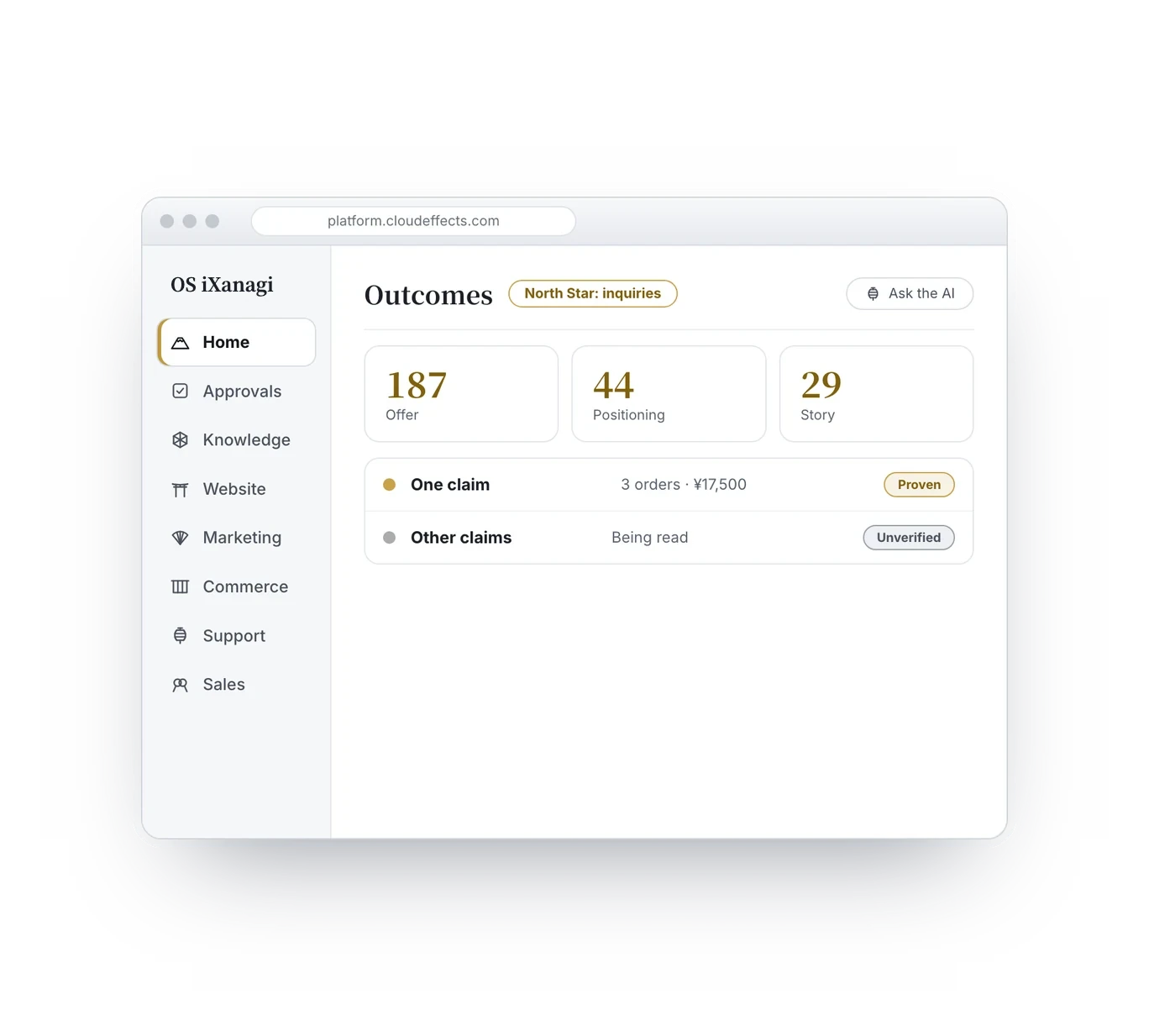
An inquiry, a sign-up, an order — whatever you decide counts as an outcome shows on the “Outcomes (30 days)” card as the number that landed. Open it each month and you can see whether it is growing.

Under the count is “Which claim produced them”. Because every number has an address, you can see which aim is producing outcomes and which is not yet.

“Today’s Suggestions” shows your business maturity as a version number: how many of six areas — knowledge, presentation, analytics, strategy, product and customers — have outcomes starting to flow.

Outcomes (30 days)Sample screen — figures are illustrative
  1. Not measured
    Month 1v1.3 · 38
  2. 0
    Month 2v2.3 · 56
  3. 4
    Month 3v3.2 · 63
  4. 11
    Month 4v4.2 · 81
  • Business maturity (version · score)

“Not measured” is a month before an outcome goal was set. It is shown apart from a month that was measured and landed 0.

Which claim produced them (month 4)

  • The “study plan” aim7
  • The “exam anxiety” aim1
  • Not tied to a claim3
These are not CloudEffects’ results. This is how it appears once your site is on it.

Where it is headed

Profit=Revenue−Cost

Both sides, turned by the same mechanism.

Usually the tools that raise revenue and the tools that cut cost are separate and know nothing of each other. Here, an answer given to a customer becomes the next article.

You define the North Star.

How many inquiries, how many requests, how much revenue. What counts as the outcome is yours to define. The AI’s proposals head toward the North Star you set.

No proposal without a reason

A proposal that cannot say which direction it moves your business is not allowed out.

No skipping stages

It will not recommend the next stage before the previous one is met. It is not built to push what we want to sell.

No false certainty

Until the link to outcomes is measured, we say “estimated to help (unmeasured)” and never state it as fact. Silence is never allowed to read as “fine”.

FAQ

What people ask.

  • Traditional SaaS gives you disconnected features connected by APIs. OS iXanagi models your entire business domain as one semantic structure. Every application is an instantiation of the same ontology.

  • Every operation declares what it does — read, write internally, send outward, publish, move money, delete, issue credentials, decide — and is handled accordingly. Reading and internal writes run with the asker's permissions, and internal edits keep the previous version. Sending, publishing, money and deletion happen only with your approval, or within a scope, budget and time limit you set when delegating to the AI. The AI cannot issue credentials, and decisions are made by people.

  • Yes. OS iXanagi includes an 8-module migration pipeline: Import, Extraction, Interpretation, Candidates, Mapping, Apply, Audit, and Post-Migration. For WordPress sites, the pipeline handles both content and structure migration. No server changes required.

  • No. OS iXanagi is model-agnostic – it is an execution platform, not an AI model. It currently connects to Anthropic (Claude) and OpenAI (GPT). The AI sits outside as a replaceable part; swap it and your assets do not move.

  • Containerized platform with Docker services. Each tenant gets isolated data with shared infrastructure.

  • Public prices, in USD. OS iXanagi is $299 a month per brand with every App, every Connector except LINE and WhatsApp, and 5,000 AI credits a month — about 1,000 AI chats or 50 articles ($199 for founding customers, fixed for 12 months). LINE, WhatsApp and voice capture are add-ons at $19 a month each. Each additional brand is $149 with 2,500 credits. Credits stop at the included amount unless you choose otherwise. Enterprise starts at $15,000 a year and Dedicated at $2,500 a month, by quote. Prices are provisional while we tune them.

  • CloudEffects is the company; OS iXanagi is the product we build.

  • It is pronounced “O-S Izanagi.” The name comes from Izanagi, from Japanese mythology. It is also a play on words: iXanagi reads as “Intelligence X an AGI.” AGI usually stands for Artificial General Intelligence; here we read it as Artificial Governed Intelligence — AI that people govern.

  • No. We first read it in and turn its content into a map. Whether to rebuild is a separate choice you make later.

  • General availability is planned for November 2026 or later. Until then we work with customers individually.

  • To see how your business is actually doing. We connect only with your explicit consent. Analytics and search data are read-only. When you connect an inbox, we ask for permission to send and receive. You can revoke access from your Google account settings.

  • No. Sending, publishing, money and deletion happen only with your approval, or within a scope, budget and time limit you set when delegating to the AI. Without approval it stops there. Drafts and internal edits are made by the AI, and the previous version is kept.

  • Yes. What the AI did, and who approved it, stays on record. You can trace it later.

  • No. Your company’s information stays in your company’s space. Even brands within one company are kept apart.

  • No. Changes go one at a time, confirmed as they go. Before anything is applied you can see what will change.

  • The main actions are reading and deciding. But since a person decides what is right, it needs someone who knows the business.

  • If you do not approve, it stops there. And the reason for the proposal is kept, so you can trace the cause.

  • With ChatGPT you explain your company every time. OS iXanagi remembers it, and proposes before you ask.

Defined

Your business definition, written with the AI.

Put your business into words, then translate it onto the OS iXanagi foundation. That step is the strength of this OS. Once it is defined, sign up and move straight on to automation.

  1. Talk with the AI Whose problem you solve, and how. You only answer what it asks.
  2. Your business definition takes shape Your answers become a document that defines your business. Correct anything on the spot.
  3. Translated onto the OS iXanagi foundation The definition is translated into ground the AI can work on. This step is the strength of this OS.
  4. Sign up and automate When the definition is right, sign up. The setup for your business comes up.
Understand structure. Connect knowledge. Shape the future.